We use cookies and similar technologies on our digital services. Some are essential for their operation, while others help us understand usage patterns to ensure quality and enhance the user experience. With your consent, we may also use cookies to optimize advertising. Click 'Manage Cookie Preferences' to adjust your settings.
The Cost of Commercial Solar Panels in Canada: ROI, Incentives, and Payback
Investing in commercial solar power in Canada is a strategic move that will lock in energy costs, provide favourable IRR and NPV, and strengthen sustainability initiatives. This guide explains what influences commercial solar costs, how incentives like the Clean Technology Investment Tax Credit (CT ITC), Accelerated Capital Cost Allowance (ACCA), and sale of carbon credits grow your bottom line, and how to optimize your building for solar.
Key takeaways:
The financial investment required for commercial solar
What makes a commercial roof good for solar
Clean Technology Investment Tax Credit 30% of system cost
Accelerated Capital Cost Allowance (CCA) 55% depreciation in 1st year
Positive Net Present Values (NPV) and Internal Rates of Return (IRR) often ranging from 12% to 18%
Sale of Carbon Credits with Carbon by Kuby
How to optimize your roof design for new construction
How much does commercial solar power cost in Canada?
In Canada, the cost of commercial solar varies significantly based on scale, from smaller agricultural operations to large industrial warehouses.
The cost of solar is best analyzed using the metric “dollar per watt” ($/W), which provides a standard unit of measure for the total installed price. This dollar per watt ($/W) is similar to $/sq. ft. in other industries.
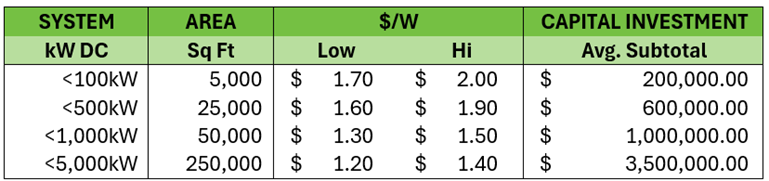
Systems that are <100kW will be approximately $1.70 - $2.00/W or up to $200,0000
Systems that are 100 to 500kW will be approximately $1.60 - $1.90/W or $190,000 to $800,000
Systems that are 500 to 1,000kW will be approximately $1.30 - $1.50/W or $750,000 to $1,300,000.
Systems from 1,000 to 5,000kW will be approximately $1.20 to $1.40/W or $1,400,000 to $6,000,000.
The following table provides a typical price range for various commercial solar systems in Canada, categorized by capacity and the corresponding approximate capital investment.
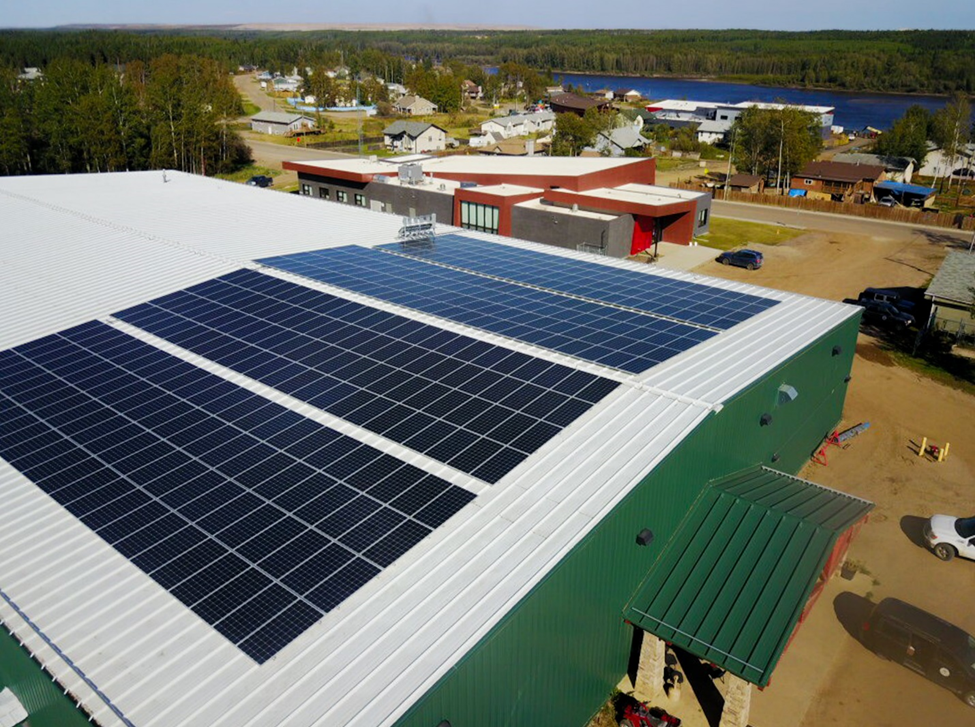
As a rule of thumb, each kW of solar will take approximately 50 square feet of roof area when installed on a flat roof. Sloped roofs will require less area per kW. Ground mounted arrays will take more area per kW.
The available area influences the economics of the solar array in several ways:
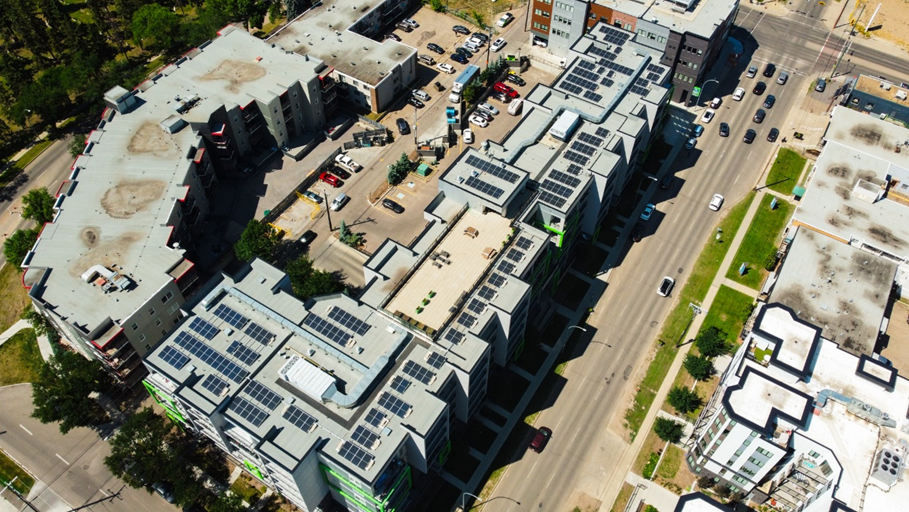
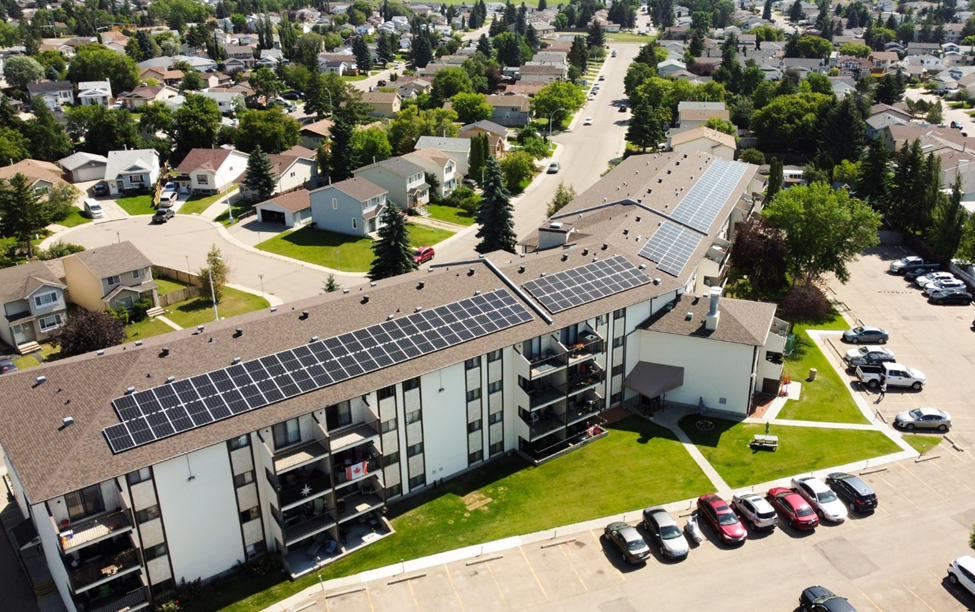
Roof Obstructions: The number of vents and equipment present play a major factor. A 10,000 sq ft multifamily residential building with hundreds of vents may not be as profitable as a 7,000 sq ft warehouse that has no roof obstructions.
Roof Type: Sloped roofs are typically more cost-effective than flat roofs.
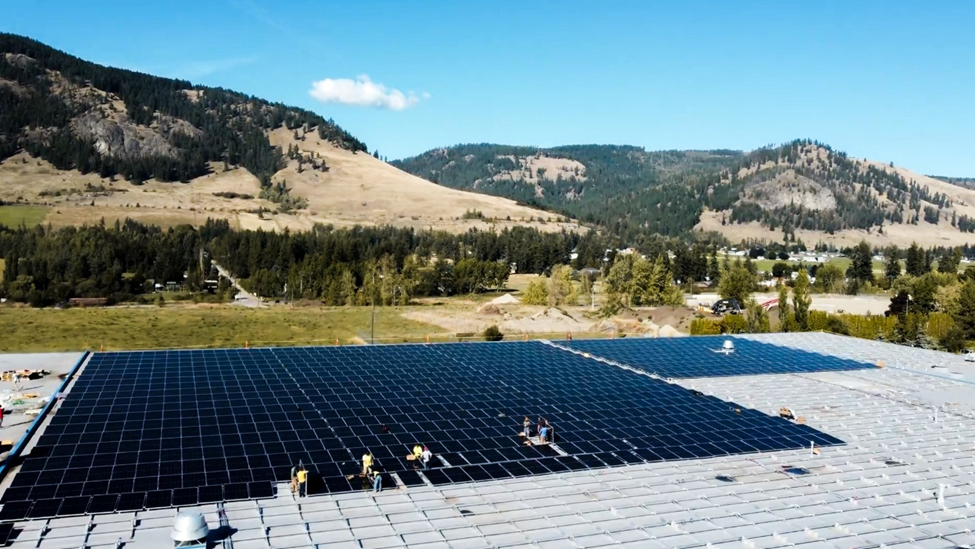
Layout: Projects featuring large, consolidated array areas are much more cost-effective than those that require multiple, smaller installations spread across the roof. This is mainly due to reduced complexity in wiring and racking.
What Determines the Cost of Commercial Solar?
The cost of a commercial solar panel system is driven by several factors:
System Size and Scale: This is the primary driver. A 50kW system on a farm will have a significantly different cost profile than a 1,500kW system on a large-scale industrial facility. Larger projects benefit from economies of scale.
Roof Complexity: The roof material, pitch, and available space determine the type of racking system needed, influencing the total installed cost. Sloped roofs are typically more cost-effective than flat roofs. Large open areas are typically more cost-effective than multiple smaller arrays.
Structural Requirements: Commercial buildingsrequire structural engineering assessments to verify the loading of the array on the building. Sometimes building upgrades are required but sometimes alternate methods can be employed. Flat roof arrays are typically ballasted using concrete bricks. If needed, concrete ballasting can be substituted for anchors into the roof to reduce the total system mass.
System Type and Integration: How your building is connected to the grid may impact costs, especially on larger arrays >500kW. Complexities such as batteries or generators or may also add cost. Kuby’s electrical engineering team will assess all of this during preliminary stages of the process.
Interconnection Specifics: Commercial installations can involve complex interconnection agreements and permitting processes with the utility provider. This is where Kuby’s professional engineers provide technical expertise to ensure a seamless process.
Maximize Your ROI: Leveraging Canada’s Top Solar Incentives
The Canadian government has made investing in a commercial solar installation exceptionally appealing through key federal tax incentives, designed to accelerate your ROI and drastically lower the net project costs.
Clean Technology Investment Tax Credit: This is a game-changer. Businesses investing in solar can claim a refundable tax credit of up to 30% of the total capital costs. This means you can receive cash back or a tax reduction from the investment, dramatically reducing the initial upfront costs.
Accelerated Capital Cost Allowance: Under Classes 43.1 or 43.2 you can write off the cost of your solar equipment much faster than normal. The accelerated CCA allows for 55% depreciation of eligible property in the first year it’s available for use, reducing your taxable income immediately and improving cash flow.
Carbon Credits (Alberta): Businesses in Alberta can generate a new, long-term revenue stream by selling their carbon offset credits, a benefit that significantly reduces your net project costs.
Solar Club: Some smaller commercial systems may be eligible for the Alberta Solar Club available through Utilities by Kuby. Through this program you can buy/sell energy at low and high rates throughout the year.
Kuby’s expertise ensures that your project is fully compliant to capture the maximum benefit from this stacking of incentives.
The CFO’s Guide to Commercial Solar ROI & Payback
Commercial solar is about financial returns, risk mitigation against rising energy costs, and maximizing tax benefits. The initial investment secures a fixed energy rate for 25+ years, fundamentally changing your operational budget.
We know at the end of the day, the numbers must make sense.
Internal Rate of Return: This is a primary commercial metric. Depending on the size of system and incentives available, Commercial solar systems can have IRR’s > 15%.
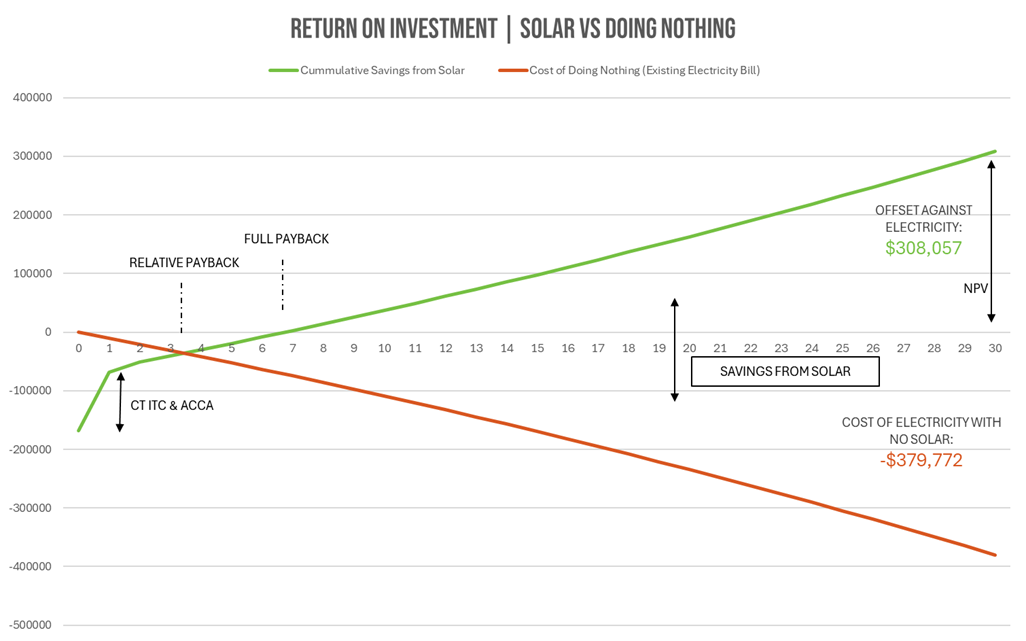
System Payback: The simplest metric. This is the exact year when your cumulative savings exceed your net installed cost.
Relative Payback: This metric compares your cumulative savings to the cost of not going solar (i.e., what you would have paid your utility company), highlighting the opportunity cost of delaying the investment.
Important Note: The cost of electricity is most likely to increase over the next 30 years. This typically happens at 2-5%/yr.
Net Present Value: The NPV calculates the total value of the investment today, accounting for the time value of money over the system’s entire 30-year lifespan and variable discount rates.
Levelized Cost of Energy (LCOE): LCOE is your projected cost to generate each kWh of electricity over 30 years. This is valuable to compare the cost of solar electricity with the cost of grid electricity over a long period.
Solar Economics for Executives, CFO’s and Accountants:
It is often the case that no single metric will paint the entire picture.
Using multiple metrics together will provide the framework that is most applicable to your specific business.
NPV and Payback Period are sufficient for many businesses. Others may look at Relative Payback Period and IRR as the primary drivers.
Costs and systems will vary, but commercial solar arrays will almost always pay back within 1/3 of their warrantied life.
Important Note: To best understand your businesses metrics, review the legislation around Class 43.1 and 43.2 and the CT ITC program specifics.
Commercial Real Estate: Boosting Valuation with Yield on Cost
For Commercial Real Estate Owners we highlight the Yield on Cost and Revenue Capitalization to demonstrate how solar increases the net operating income (NOI), property capitalization rates (cap. rate) and overall property valuation.
Is my building optimized for solar power?
Some buildings are more favourable than others.
As system size is one of the biggest drivers of economics, roof/building area is directly correlated. If you have a large building, it is more likely to be applicable for solar.
Beyond the size of the building, the applicable roof area is key. How many obstructions are on the roof is a major factor.
A 10,000 sq ft multifamily residential building with hundreds of vents may not be as profitable as a 7,000 sq ft warehouse that has no roof obstructions.
But it certainly still can be profitable!
To assess the potential of your building, Kuby offers free quotes to give you reliable ballpark information. Depending on your site location, we provide free on-site consultations to further refine our estimates into a hard cost.
Whether your roof is flat, faces east/west, or directly south is not a major factor for commercial installations as the size of systems typically more than makes up for the decrease in efficiency from ‘non-ideal’ azimuths.
Harnessing Alberta and BC’s Unique Energy Markets
The financial returns of your solar investment are highly dependent on how your utility bill is structured.
Commercial Solar in Alberta
Solar in AB is subject to net billing and the micro generation regulation.
Systems less than 5MW are able to apply as micro-generators, as long as the system production meets the site’s energy consumption.
Energy is sold back to the grid at the same rate that it is purchased for, approximately $0.05/kWh to $0.15/kWh. You may be able to take advantage of the solar club which would allow you to sell back energy at $0.30/kWh.
This exchange is called net billing, where you sell back your energy for a dollar credit.
It is important to note that many commercial solar systems are eligible for Solar Club benefits if they are classified as a small micro-generation site, meaning the system capacity is under 150 kW. These programs allow you to “buy low and sell high” by switching between high and low electricity rates seasonally.
Commercial Solar in BC
Solar in BC is subject to the self-generation program.
Commercial installations in BC can sell back excess energy for systems that are <100kW AC.
You can install larger system’s but you won’t be able to sell back excess energy. This energy would then be clipped (wasted), or stored in a battery if applicable.
Systems that are eligible for self-generation are able to sell back excess energy at a 1:1 kWh credit. This exchange is called net metering, where you are credited at a kWh rate.
BC Hydro’s Load Displacement Program will provide incentives for commercial arrays to reduce their imported energy. You still won’t be able to export energy to the grid, but you will get a cash incentive which is more beneficial.
Large consumers with high energy consumption are ideal candidates for the load displacement program.
How Solar Delivers a Measurable Sustainability Win
For the ESG-Driven Business Owner, solar is the perfect confluence of ethics and economics. Your investment not only strengthens the bottom line, but also provides an immediate, measurable ESG win that benefits your corporate reputation and investor relations.
By adopting solar, your business:
Improves ESG Scores: Investors and stakeholders increasingly prioritize Environmental, Social, and Governance (ESG) performance. Commercial solar is a simple, low-cost sustainability solution that provides tangible, measurable data for impact verification.
Demonstrates Leadership: Solar positions your company as an industry leader committed to corporate social responsibility, attracting sustainability-conscious customers and top talent.
Future-Proofs Operations: Investing in clean energy helps future-proof your business against changing environmental regulations and carbon pricing schemes.
Choosing Kuby ensures a seamless ESG integration. We don’t just sell panels. We provide the data you need to communicate your positive environmental impact to the market.
Commercial Solar FAQ’s: Quick Answers for Decision-Makers
1.What is the typical payback period for commercial solar in Canada?
The typical relative payback period for a commercial solar system in Canada is around 3 to 4 years, a substantial reduction from the average 5-7 year relative payback period you’d see from a standard residential solar system. This is achieved by strategically utilizing the federal incentives like the CT ITC and the ACCA. This allows your business to quickly recover the initial capital expenditure on your solar system and enjoy decades of virtually free power and massive long-term operational savings.
2.What incentives are available for commercial solar in Alberta?
The financial incentives for commercial solar in Alberta are exceptional, designed to drastically reduce your net project cost.
Clean Technology Investment Tax Credit (CT ITC): A refundable tax credit of up to 30% of your project cost, which immediately reduces your tax liability or provides a cash refund.
Accelerated Capital Cost Allowance (ACCA): Allows you to claim 55% depreciation of solar equipment in the first year of operation, providing a major reduction in your taxable income.
Carbon Credits (Carbon by Kuby): Creates an annual, passive revenue stream by selling the verifiable carbon offsets generated by your clean energy production.
Net Metering: Provides credit on your utility bill for any surplus electricity your system exports back to the grid.
Solar Club Eligibility: Maximizes your financial return by allowing small micro-generation sites (under 150 kW) to strategically buy and sell electricity at high rates seasonally.
Clean Energy Improvement Program (CEIP): Offers long-term financing with repayment made through property taxes, eliminating the need for significant initial capital.
3.Can my business claim the Clean Technology Investment Tax Credit?
Yes, your business can claim the CT ITC! This is a refundable tax credit of up to 30% of the cost of eligible property, including commercial solar equipment. The goal of the CT ITC is to encourage businesses to invest in clean technologies that generate electricity for use in their operations, making your solar project immediately more affordable and accelerating your ROI.
4.How does commercial solar affect my building's value?
Commercial solar systems have long-term financials that are locked in. The remaining value of the asset can easily be quantified. Valuation increases are driven by two main factors:
Increased Net Operating Income (NOI): Solar reduces operating expenses (utility costs) and/or creates new revenue (through roof leases or energy sales). Because property valuation is based on NOI (Income/ Capitalization Rate), every dollar saved or earned directly translates into increased building value.
ESG & Tenant Demand: Solar-equipped properties are more attractive to ESG-conscious investors and command higher tenant retention and potentially higher lease rates. The system acts as a valuable infrastructure asset that future-proofs the building.
Your Trusted Partner for a Sustainable Bottom Line
Investing in commercial solar is one of the smartest strategic capital expenditures a business can make in Canada. It is a decision that moves your company toward true energy resilience and profitability.
At Kuby, we are Powered by People and built on a technical-first foundation, blending trusted expertise and exceptional quality into every commercial project. We remove the complexity of commercial solar, giving you the straightforward and confident partnership you need to make the right decision.
Our commitment is simple: Solar Simplified. People Powered. We deliver long-term savings and a sustainable future for your business.
Ready to see how much money solar can save your business?
Go Solar Today
Save money. Become independent. Protect the environment.




.svg)
.svg)


.svg)

.svg)



.png)

.svg)
.svg)

