We use cookies and similar technologies on our digital services. Some are essential for their operation, while others help us understand usage patterns to ensure quality and enhance the user experience. With your consent, we may also use cookies to optimize advertising. Click 'Manage Cookie Preferences' to adjust your settings.
Alberta's main solar incentives come from the Solar Club export premiums and the Clean Energy Improvement Program long term low interest financing. In BC, BC Hydro offers rebates of up to $5,000 for eligible residential solar, plus up to $5,000 in battery rebates and no PST. Commercial businesses across Canada may also qualify for the federal 30% Clean Technology Investment Tax Credit and 100% accelerated capital cost allowance.
Wondering if there are any rebates or incentives for solar panels in Alberta or BC? You're not alone. Programs open, close and change every year, and old lists online make it hard to tell what's still available. This guide covers what's open in Alberta and British Columbia as of November 2026, what has closed, and where to check the current terms.
Solar incentives may be issued by the federal government, a provincial government or utility, or your municipality.
What federal solar incentives are available in Canada?
Three federal programs can apply: Accelerated Capital Cost Allowance, the Clean Technology Investment Tax Credit for eligible businesses, and the CMHC Eco Improvement for some homeowners. The federal programs for businesses can be stacked and result in approximately 40% discount.
100% CCA (for businesses)
Eligible corporations can write off 100% of the asset in year 1 in accordance with class 43.1 and 43.2 of the Income Tax Regulation.
The 30% Clean Technology Investment Tax Credit is available for eligible businesses, not homeowners. According to the CRA, it can be claimed by taxable Canadian corporations and certain real estate investment trusts on new solar equipment used in Canada. Under current rules, the rate is up to 30% for property that becomes available for use by December 31, 2033, and up to 15% in 2034. Budget 2026 proposes extending the 30% Clean Technology Investment Tax Credit to property available for use before 2041, with the rate stepping down to 15% in 2040; that's a proposal, not yet law. Conditions apply, so confirm with CRA and your tax advisor, and read our full guide to the Clean Technology Investment Tax Credit.
CMHC Eco Improvement
If your home has a CMHC-insured mortgage, CMHC's Eco Improvement program may refund part of your mortgage insurance premium after energy upgrades. Check CMHC's Eco Improvement page for current eligibility before you count on it.
What solar incentives are available in Alberta?
In Alberta, there are two main incentives - CEIP Financing and the Solar Club offered by Utilities by Kuby. There are occasional local programs through various municipalities that come and go and typically have a very limited lifecycle.
Clean Energy Improvement Program (financing)
The Clean Energy Improvement Program (CEIP) isn't a rebate. In participating Alberta municipalities, CEIP lets homeowners finance solar through their property tax bill.
Rates, terms and how much of the project it can cover are set by the program. Check the CEIP site for the current terms in your municipality.
Want to compare it with other ways to pay? See what solar panels cost, or ask us: low-interest financing options are available, so ask us what's current.
Solar Club - Net Billing Supercharged
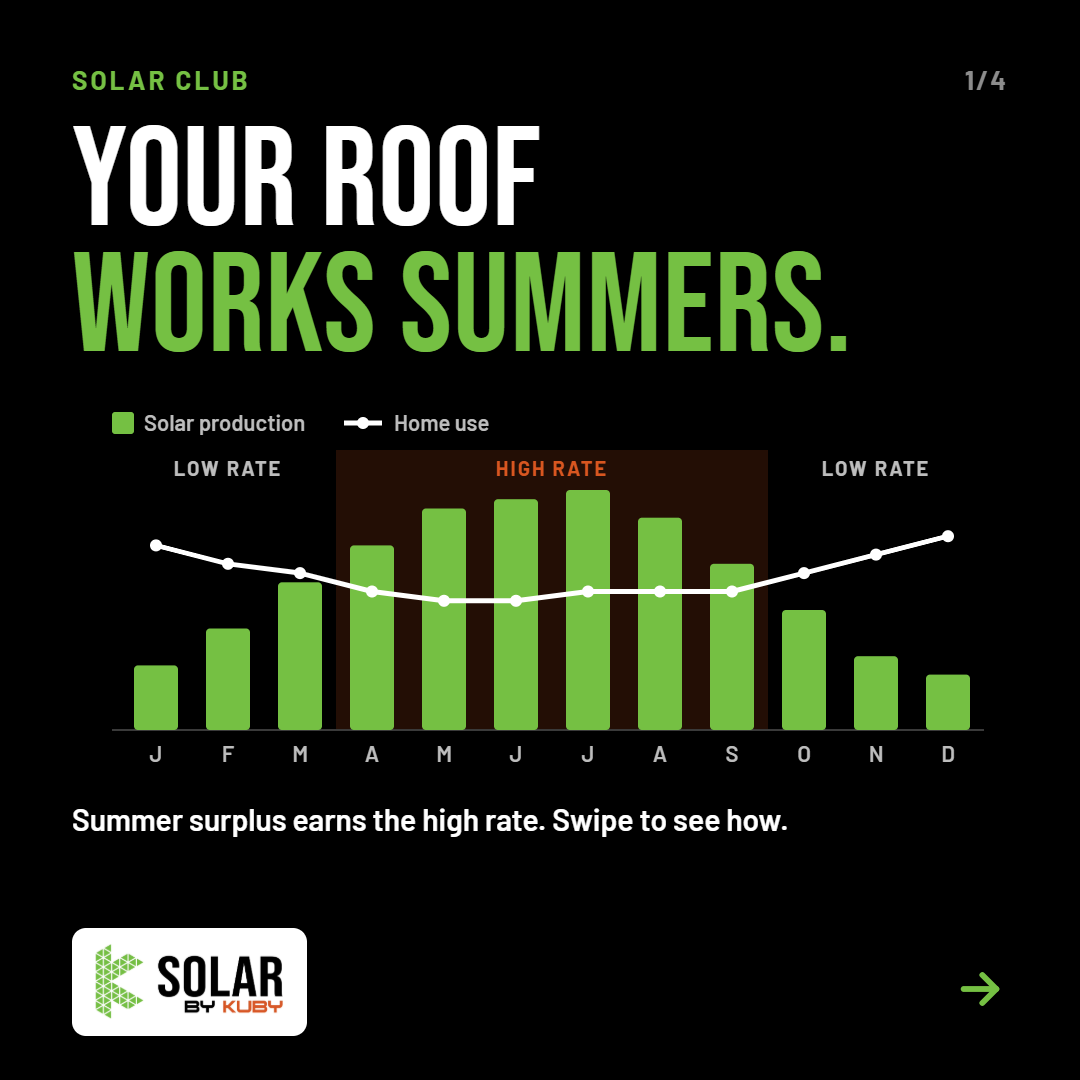
In Alberta, standard net billing allows solar owners to be credited for the extra electricity they send to the grid. The solar club supercharges this system by charging you a higher electricity rate when you are exporting more energy than you consume, and switch you back to a low rate when you are importing more than you export.
The Town of Canmore's 2026 solar incentive intake (February 2 to March 31, 2026) has closed. If your application was selected, installation and electrical inspection must be completed by December 15, 2026.
Canmore residents and business owners who missed this round can watch the Town of Canmore website for any future intake. If Canmore runs another round, it suits anyone who'd rather have a straightforward reward than a long-term loan.
What solar incentives are available in BC?
BC Hydro offers rebates of up to $5,000 for eligible residential solar + up to $5,000 for eligible battery installations. BC Hydro offers a lucrative load displacement program for businesses looking to go solar. All of BC is exempt from BC's 7% PST for solar PV equipment.
BC Hydro solar and battery rebates
As of November 2026, BC Hydro offers rebates of up to $5,000 for eligible residential solar ($1,000 per kW, up to half the installed cost), plus rebates for eligible batteries. Amounts and eligibility are set by BC Hydro, so check BC Hydro's solar and battery rebate page before you budget.
BC Hydro Load Displacement (for businesses)
BC Hydro's Load Displacement program offers businesses an incentive that has worked out to approximately $0.45/kWh for the energy their on-site generation displaces in the first year. See BC Hydro's Load Displacement incentives for eligibility and current terms.
BC Hydro Self-Generation (net metering)
With BC Hydro's or FortisBC's self-generation programs, you can send unused solar power back to the grid in exchange for credits. Pre-approval is required before installation. Read the full details on BC Hydro's Self-Generation program.
While not directly tied to solar, many homeowners interested in clean energy also look at EV incentives. CleanBC's Go Electric program has offered rebates for EV chargers and some electric vehicles; check CleanBC Go Electric for what's open now and whether pre-approval is required. Thinking about a charger at home? See our EV charging page.
Frequently Asked Questions
Common questions about solar rebates and incentives in Alberta and BC.
Is there a solar rebate in Alberta right now?
Alberta doesn't have a province-wide cash rebate for home solar. The main programs are CEIP financing in participating municipalities and bill credits for the power you export; some towns, like Canmore, have run their own incentive rounds.
Is CEIP a grant or a loan?
CEIP is financing, not a grant. In participating Alberta municipalities, it lets homeowners finance solar through their property tax bill. Check the CEIP site for current terms in your municipality.
Can homeowners claim the 30% Clean Technology Investment Tax Credit?
No. CRA limits the Clean Technology ITC to eligible businesses, such as taxable Canadian corporations. Homeowners should look at CEIP financing, net billing credits and BC Hydro's rebates instead.
Does solar still pay off in Alberta's winter?
In Alberta, summer generation pays for winter usage when your system is sized close to your home's yearly use; a smaller system covers part of it. How far your credits go depends on your system size, roof and usage.
How do I know which programs I qualify for?
Start with where you live: your municipality (for CEIP), your electricity retailer (for export rates) or BC Hydro (in BC). Not sure what you qualify for? Ask us.
Need help navigating solar incentives?
Programs change often, and it's hard to tell what's still open. That's why our team is happy to walk you through what applies to your home or business, from federal credits to municipal programs.